More than 200 years after being sunk by Adm. Horatio Nelson and the British fleet, a Danish warship and part of a sailor's jaw have been discovered on the seabed of Copenhagen Harbor by marine archaeologists.
Working in thick sediment and almost zero visibility 50 feet beneath the waves, divers are in a race against time to unearth the 19th-century wreck of the Dannebroge before it becomes a construction site in a new housing district being built off the Danish coast.
Denmark's Viking Ship Museum, which is leading the monthslong underwater excavations, announced its findings on Thursday, 225 years to the day since the Battle of Copenhagen in 1801.
"It's a big part of the Danish national feeling," said Morten Johansen, the museum's head of maritime archaeology.

A great deal has been written about the battle "by very enthusiastic spectators, but we actually don't know how it was to be onboard a ship being shot to pieces by English warships and some of that story we can probably learn from seeing the wreck," Johansen said. The Associated Press was the only international outlet given access to the site.
In the Battle of Copenhagen, Nelson and the British fleet attacked and defeated Denmark's navy as it formed a protective blockade outside the harbor.
Thousands were killed and wounded during the brutal hourslong naval clash, considered one of Nelson's "great battles." The intention was to force Denmark out of an alliance of Northern European powers, including Russia, Prussia and Sweden.
"A nightmare to be on board"
At the center of the fighting was the Danish flagship, the Dannebroge, commanded by Commodore Olfert Fischer.
The 157-foot Dannebroge was Nelson's main target. Cannon fire tore through its upper deck before incendiary shells sparked a fire aboard.
"(It was) a nightmare to be on board one of these ships," Johansen said. "When a cannonball hits a ship, it's not the cannonball that does the most damage to the crew, it's wooden splinters flying everywhere, very much like grenade debris."
The battle also is believed to have inspired the phrase "to turn a blind eye." After deciding to ignore a superior's signal, Nelson, who had lost sight in his right eye, reportedly remarked: "I have only one eye, I have a right to be blind sometimes."
Nelson eventually offered a truce and a ceasefire was later agreed with Denmark's Crown Prince Frederik.
The stricken Dannebroge slowly drifted northward and exploded. Records say the sound created a deafening roar across Copenhagen.
Four years later, in 1805, Nelson was killed by a French sniper and his crew pickled his body in brandy so that he could returned home and not buried at sea, historians told the BBC last October.
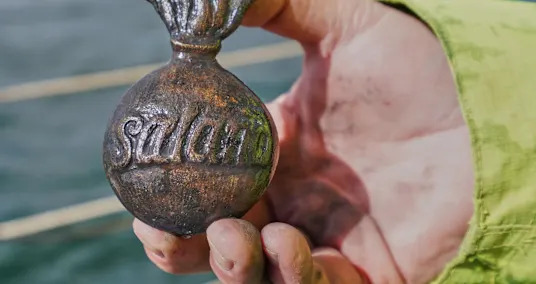
Marine archaeologists have discovered two cannons, uniforms, insignia, shoes, bottles and even part of a sailor's lower jaw, perhaps one of the 19 unaccounted-for crew members who likely lost their lives that day.

The dig site will soon be enveloped by construction work for Lynetteholm, a megaproject to build a new housing district in the middle of Copenhagen Harbor that is expected to be completed by 2070.
Marine archaeologists began surveying the area late last year, targeting a spot thought to match the flagship's final position.
"You get closer to the people onboard"
Experts say the sizes of the wooden parts found match old drawings. Dendrochronological dating, the method of using tree rings to establish the age of wood, match the year the ship was built. They also say the darkened dig site is full of cannonballs, a hazard for divers navigating waters darkened by clouds of silt stirred up from the seabed.
"Sometimes you can't see anything, and then you really have to just feel your way, look with your fingers instead of with your eyes," diver and maritime archaeologist Marie Jonsson said.
Chronicled in books and painted on canvases, the 1801 battle is deeply embedded in Denmark's national story.
Archaeologists hope their discoveries may help reexamine the event that shaped the Scandinavian country and perhaps uncover personal stories of those who went into battle on that day 225 years ago.
"There are bottles, there are ceramics, and even pieces of basketry," Jonsson said. "You get closer to the people onboard."

The discovery was announced just weeks after a 17th century Swedish Navy shipwreck buried underwater in Stockholm for 400 years suddenly became visible due to unusually low Baltic Sea levels.
In 2024, archivists opened parcels from the Anne-Marie cargo ship, which was seized by the British Navy during the Second Battle of Copenhagen, finding a sweater, stockings, silver coins and other items from the ship.
In 2023, divers discovered a Dutch warship off the coast of southern England that sank in 1672.
JPMorgan Chase CEO Jamie Dimon weighs in on Iran war's economic impacts
Hawaii doctor's son testifies that his father confessed to trying to kill his stepmother
Watch: Artemis II launches on historic moon mission | Special Report
latest_posts
- 1
 Jennifer Lawrence and Josh Hutcherson to reprise their roles for new 'Hunger Games' movie 'Sunrise on the Reaping'
 - 2Vote In favor of Your Favored Language Learning Applications
- 321 Things You Ought to Never Share with Your Childless Companion
- 4US FDA grants market authorization to six on! PLUS nicotine pouch products
- 5Putting resources into Yourself: Self-awareness Techniques





- Charli xcx teases new film ‘The Moment’: What to know about the A24 movie
- Apollo's impatient old-timers are rooting for NASA's return to the moon with Artemis II launch
- Is relief in sight? Flu season still brutal but cases are declining.
- Wellness Bits of knowledge Readily available: A Survey of \Following Wellbeing and Progress\ Wellness Wearables
- What is colostrum? And should you be taking it?
- A single shot of HPV vaccine may be enough to fight cervical cancer, study finds
- 7 Methods for further developing Rest Quality
- AI is making spacecraft propulsion more efficient – and could even lead to nuclear-powered rockets
- Space Condos to Lift Your Metropolitan Living