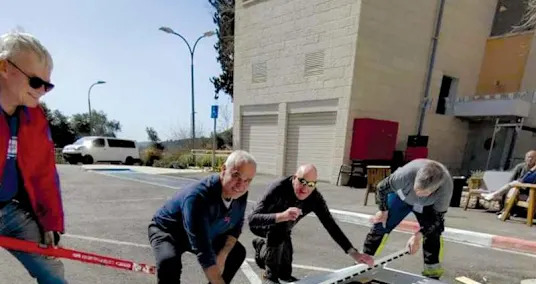
Mehran Rezvani, who grew up in Iran during the Islamic Revolution, has become a devoted supporter and volunteer for Israel.

‘Truth is stranger than fiction” goes the time-tested saying coined by Lord Byron in 1823.
The relevance of that quote crossed my mind recently when I interviewed perhaps one of the most unlikely volunteers in Israel today: 60-year-old Mehran Rezvani, who was born and raised in Qaem Shahr, one of the largest cities in northern Iran.
Rezvani is part of a group of eight Norwegian volunteers at the Eitanim Mental Health Center outside Jerusalem, on behalf of Nachamu Nachamu Ami, a Dutch organization that provides humanitarian assistance to Jewish people in the Diaspora and Israel.
My phone interview was conducted with Rezvani and assisted by his fellow volunteer Kenneth Reinhardtsen, who translated his remarks from Norwegian to English.
Rezvani was 14 when the Shah of Iran was overthrown and Ruhollah Khomeini came to power. He was indoctrinated with the anti-Israel and antisemitic feelings that swept through Iran at that time; but as he grew older, he became disenchanted with the political system in Iran.
In 1986, Rezvani, a member of the Iranian weightlifting team, competed in the Asian Games in Seoul and won a bronze medal. During his stay in South Korea, Rezvani defected from Iran with three other team members and settled in Norway. Rezvani said that he chose Norway because he was told that he would be safest there from Iranian agents who might try to harm him.

After moving to Norway, he joined the country’s weightlifting team and won a gold medal at the 1990 Nordic Weightlifting Championships.
In 1995, he said, his life changed. “I started to read the Bible, and I began to believe what was written. I had been taught previously that Israel was a negative nation and the Jews were evil. But when I read the Bible, I received an entirely different perspective.” Rezvani’s views on Israel and the Jewish people changed 180 degrees.
Rezvani became a Pentecostal Christian, married a Norwegian woman, and now has three children and two grandchildren. He lives with his family in Bergen, Norway’s second-largest city, located on the west coast. He once operated a restaurant in Oslo, and today he and his wife run a company that provides coaching services.
In mid-February, he arrived in Israel on a visit and is performing maintenance work at Eitanim. After the war began on February 28, he said, his friends and family in Iran were encouraged. “They were waiting for America and Israel to help them, but then they got help and were very happy.” However, he continued, the Internet has been shut off in Iran, and he can no longer be in touch with his friends and relatives there.
Rezvani is hopeful that the regime will fall, expressed his extreme distaste for the ayatollahs and the Revolutionary Guards, and added that his family in Iran feels the same way.
Along with the other volunteers, Rezvani works five days a week in Eitanim and is enjoying his visit here, despite the war. He is planning to remain in Israel until mid-May and is staying in Kfar Shaul. He enjoys Israeli cuisine and has grown fond of the Israeli people and the atmosphere.
'When missiles fall, we take it very easy'
Judith Levin, head psychologist in the psychogeriatric unit at Kfar Shaul Mental Health Center, is grateful for assistance from volunteers such as Rezvani. “I always feel a lift when I see the overseas volunteers. I respect the quiet, hard work they do and, most of all, their support for Israel, even when the leadership in their own country might be less than supportive,” she said.
When asked about leaving his family for such an extended period of time, Rezvani replied, “My wife is in Norway, and she doesn’t mind that I am in Israel. She believes in the God of Israel and knows that He protects the country and His peace is upon Israel.
“The people here are very friendly,” Rezvani chuckled. “When I was visiting the Old City, a police officer asked me where I was from. I said I was from Iran, and at first I was a bit concerned. But he was very friendly to me.”
As our conversation came to a close, I asked Rezvani how he feels when he hears the sirens signaling the arrival of incoming missiles from his former home. “When missiles fall, we take it very easy. We feel safe, and we are not worried,” he stated.
It would seem impossible that a 14-year-old growing up during the Islamic Revolution could become a devoted supporter and volunteer for Israel. But as Mark Twain said, expanding on Byron’s famous words, “Truth is stranger than fiction. But it is because fiction is obliged to stick to possibilities; truth isn’t.”
latest_posts
- 1
 'We were genuinely astonished': This moss survived 9 months outside the International Space Station and could still grow on Earth
 - 2They want better health care — so they're turning to crypto startups
- 3Los Angeles County sees significant uptick in norovirus cases, officials say
- 415 Preposterous Cosplay Ensembles That Will Blow You Away
- 5Geminid shooting stars: One of 2025's most exciting meteor showers begins tonight




- Live long and loiter: Why NASA's ESCAPADE probes will wait a year in space before heading to Mars
- Select Your Definitive Pizza Decision
- Impact of NIH funding reductions felt in cancer and infectious disease trials
- CNN Crew Detained and Journalist Put in Chokehold in IDF Run-In: ‘We’re Journalists. What Are You Doing?!’
- Transform the daily grind to make life more interesting – a philosopher shares 3 strategies to help you attain the good life
- 'No middle ground' for tackling antisemitism after Bondi Beach mass shooting, deputy FM Haskel says
- Elanco's drug gets emergency nod to treat deadly flesh-eating parasite in cats
- Four Dead in Last Month From Animal Attacks in Nepal
- ‘Downton Abbey: The Grand Finale’ hits streaming: How to watch, cast info and everything you need to know